From deep sea shipping to Brentwood Bay


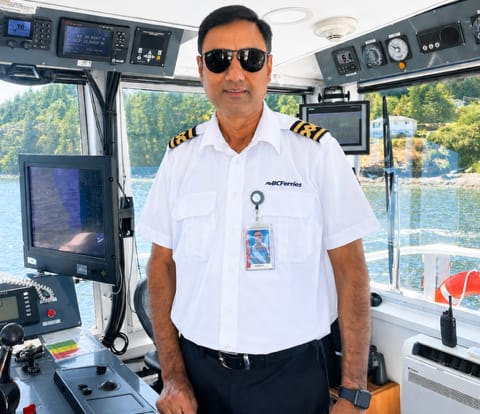
I don’t remember a time when I wasn’t passionate about the marine industry. It runs in my family. My uncle and my cousin are both captains, and growing up I always thought it was an adventurous profession.

Before coming to Canada in 2013, I spent about 14 years at sea, working on different kinds of vessels. I worked on cargo ships, tankers and other deep sea vessels, then later on tugs and barges in Ontario, Great Lakes ships and even a bunker vessel in Vancouver, delivering fuel to ships at anchor.

When I moved to Canada, I thought I’d be able to continue my career. Instead, I found out I had to start over.

I had earned my qualifications in the U.K., but Transport Canada required me to rewrite all my exams. It was a long process that took more than two years. During that time, I couldn’t work in my profession, so I worked the graveyard shift at a gas station in Kamloops to support my family while I studied.

It was a huge adjustment. I had gone from working as a chief officer on deep sea vessels to starting over from scratch. But I knew it would be worth it.

The Transport Canada exams were challenging. You didn’t just memorize answers. You had to explain everything in depth, and you never knew whether you’d passed until the results arrived. When I finally earned my Master Mariner certificate, it was one of the proudest moments of my career.

I joined BC Ferries in 2021 as a third officer. Since then, I’ve been fortunate to become a second officer, then second relief chief officer, then a chief officer. I also spent two years as a full-time sea trainer in Langdale before accepting the opportunity to become master minor on the Klitsa at Brentwood Bay, where I’ve been for the past two years.

Looking back, it has been an incredible journey.

One thing I wish more people knew is how much happens behind the scenes before every sailing. People see the ferry as a way to get from one place to another, but there is a lot of preparation, coordination and teamwork involved. We complete pre-departure checks, make sure the vessel is ready, work closely with the engineers, communicate with terminal staff and always keep safety as our top priority. Safety is never something we compromise on.

Every crew member has an important role. Professionalism, communication and teamwork are what keep the ferries running safely every day.

One moment that really stands out happened recently after a serious accident closed the Malahat. Our crew had already worked a full 12-hour shift, but because traffic was backed up and ambulances needed to get through, we were asked whether we could operate an extra sailing. I spoke to the crew. Every single person said yes. The deck crew, engineers and terminal staff all came together to help the community. We carried additional passengers and medical traffic after what had already been a long day. I was incredibly proud of everyone.

Every day brings different challenges. We work on the water, so we’re constantly dealing with changing weather, changing conditions and operational demands. As captain, I’m responsible for making important decisions while making sure we operate safely and follow company policies. It’s a job that requires focus from the beginning of the shift to the end.

What helps is knowing we have strong support around us. Training, resources and safety are things BC Ferries takes seriously. I’ve worked for several companies in Canada, and the safety standards here are among the best I’ve seen.

If I could change one thing, it would be to continue strengthening the support for the people who keep the operation running. This is a demanding job. We work long days, deal with changing conditions, provide customer service and carry a great deal of responsibility. It’s important that employees feel valued, supported and recognized for the work they do. Continued investment in training, career development and employee well-being helps us provide the best possible service to passengers.

At the end of the day, we all share the same goal: keeping our communities connected safely.

If sharing my story inspires someone else to work toward their own goals, maybe one day they’ll be at the top of their profession too. That would make me very happy.

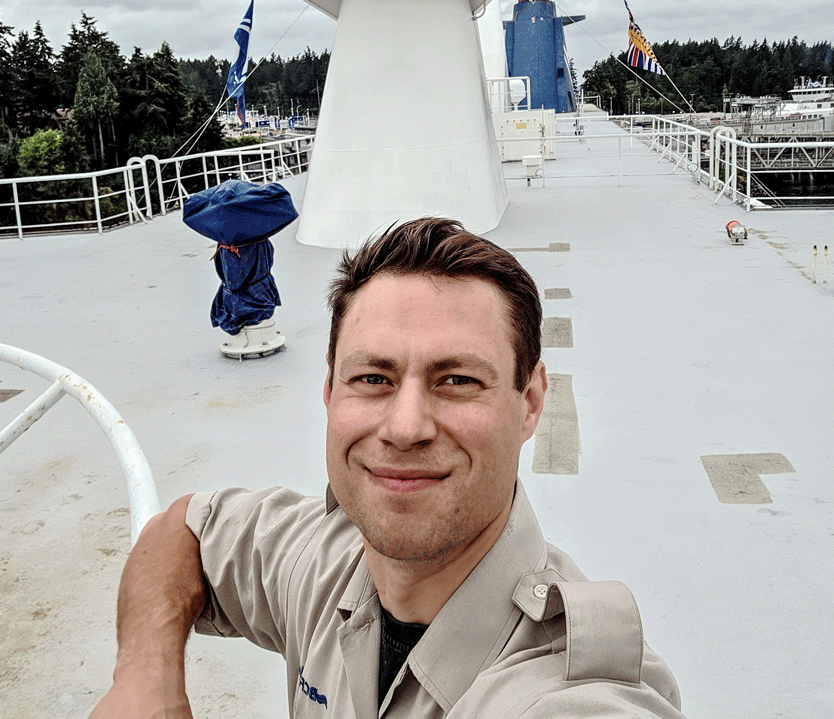
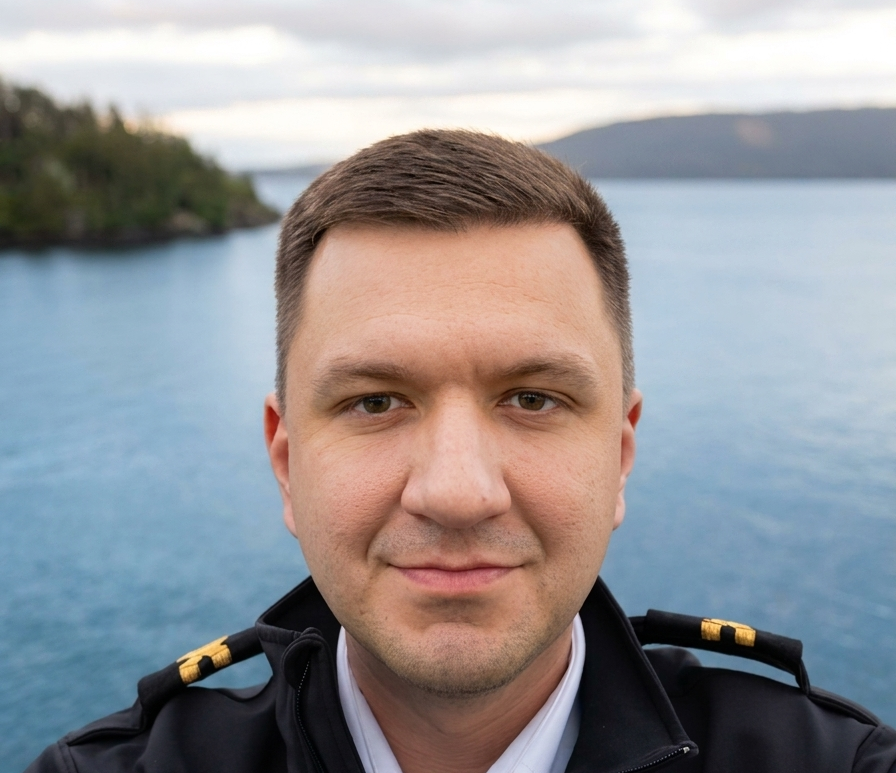
Amit Kotwal, Master Minor Brentwood Bay 

Ready when it matters most: Yegor’s story

About a year and a half ago, I almost lost my life.

My girlfriend and I were driving home from a camping trip when we hit a thick fog bank just outside Hope. Our vehicle rolled three times and I was partially ejected. I woke up two days later from an induced coma, concussed with more than two dozen broken bones including my neck and spine, internal injuries, partial paralysis and severe internal bleeding.

That experience changed everything.

Today, I’m back on deck, and every time I check emergency equipment or take part in training, I know exactly why it matters. I don’t want anyone to ever end up like me.

I joined BC Ferries 10 years ago after trying to become a firefighter. It’s a very competitive career, and a friend who had recently been hired at BC Ferries suggested I give the marine industry a try. I sold my car to pay for my marine emergency training courses and rode my bike everywhere until I finished them. Luckily, I got an interview, and I started with BC Ferries in April 2016.

I began on Salt Spring Island, where I learned the ropes aboard the Queen of Nanaimo, the Howe Sound Queen and the Skeena Queen. Looking back, those years taught me skills that I still use today.

One thing I wish the public knew is that deckhands do much more than load cars. People see us directing traffic on the vehicle deck, but behind the scenes we’re constantly training, maintaining emergency equipment and ensuring that the ship is ready to respond if something goes wrong.

One lesson has always stayed with me. You don’t rise to the level of your adrenaline. You fall to the level of your training. It’s important to do the work before an emergency happens. We train so we can respond quickly, and we maintain the ship’s emergency systems so they’ll work when people need them most.

About a year and a half ago, that lesson became deeply personal.

Recovering from the accident was the hardest thing I’ve ever done. I spent months rebuilding my strength and learning to walk again. I pushed myself in the gym for hours every day because I had one goal in mind: Doing right by the people who count on me.

When things got difficult, I pictured the ship I work on and the people I work with. I imagined what I would do if the ship was on fire or someone needed help. That helped me push one more mile on a run or lift and drag 10 more pounds than I thought I could.

Today, I’m in even better physical shape than I was before the accident. I don’t think I would have made it without my girlfriend – who had my back while recovering from her own serious nervous and physical injuries, and her mother – who opened her home to us when we had nowhere else to go. They both also work for BC Ferries, and the love and support they gave me made all the difference. I decided not to give up on myself, but more importantly, not to give up on them because they weren’t going to give up on me.

Coming back to work has been emotional. Physically, I was ready. Mentally, it took longer.

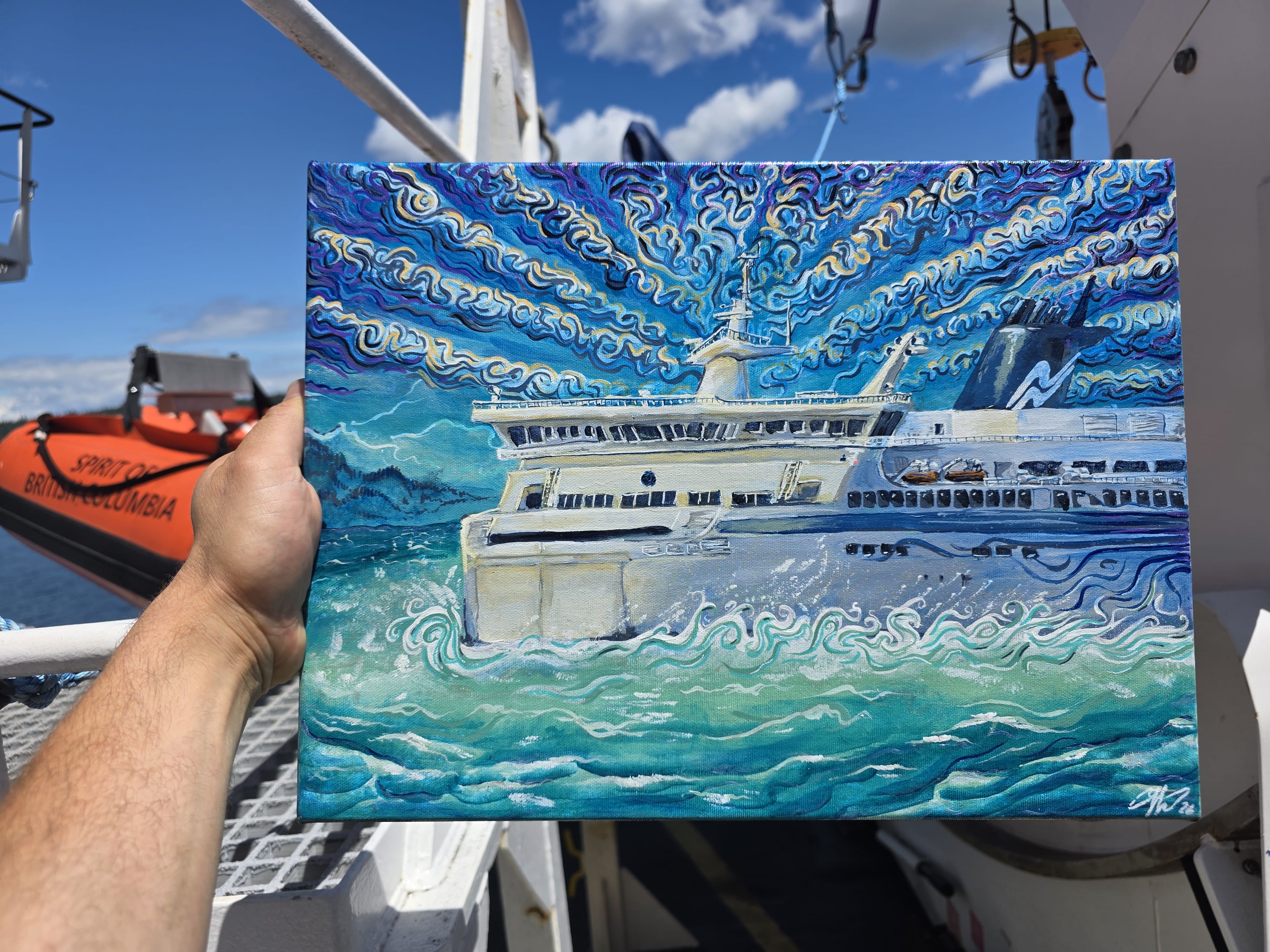
“This little painting is a gift to the crew and all the people who believed in me and cheered me on. It hangs in the mess now.”

A lot of people don’t know how to respond when someone has been through something like that. I understand it comes from a good place. I’m always happy to talk about what happened because I think it helps remove some of the stigma around asking those questions.

More than anything, my experience has reinforced why this work matters. I don’t want anyone to go through what I went through. If something happens on board, I want us to be ready. It’s easy to become complacent, but emergencies don’t happen because of one big mistake. They happen when lots of little mistakes stack up.

If somebody doesn’t stow a fire hose properly and there’s a fire, those lost minutes matter.

That’s why I tell people to take care of the vessel. If you take care of your vessel, it’ll take care of you.

Take care of the ship. Take care of your body. Take care of your mind. Take care of each other. If you see someone struggling, don’t be afraid to ask how they’re doing. Instead of gossiping, try to connect. Have each other’s backs.

That’s the kind of crew I want to be part of, and it’s why I’m proud to be back on deck.

Yegor Ludmilin, Local 3 – Tsawwassen

Finding a home away from home: Devon’s story

When I came home after spending two and a half years living abroad, I was looking for a job. My brother was working in the terminal at BC Ferries and told me to apply.

Within a year, I had a regular position. Then I got involved with the union and young worker initiatives.  I made lots of new friends and met new people through work and the union. I felt like I built a little community.

Today, I primarily work as a second steward aboard the Northern Expedition. Like most of our crew, I fly to Prince Rupert before spending 14 days living and working with the same people. You definitely feel like they’re your family or your home away from home.

The best part of my job is customer service. I like making people’s day. Sometimes it’s just a small thing for me to do, but it totally brightens a tourist’s or local’s day.

I think a lot of people just look at us as the people who serve them burgers and take their money at the till. They don’t always realize that catering crew also play a critical role in passenger safety.

In an emergency, we’d have everybody organized and know who’s who. We do a lot of preparation to make sure we’re ready if something happens.

One of the things I appreciate most about BC Ferries is the safety culture. You can see it in every department. Safety is the primary focus, then the rest is customer service.

Working the northern routes comes with challenges too. Because we’re on board for long sailings and serve alcohol, dealing with abusive behaviour from passengers can be difficult. We’re food primary licensed. You can enjoy a drink with your meal, but it’s not a party boat, as I’ve had to remind people sometimes.

One experience I’ll never forget was helping a passenger find a lost wedding ring. The cabin had already been cleaned, but I decided to take one more look. I got down on my hands and knees looking under the beds. I noticed the moulding had pulled away a bit, reached behind it, and sure enough, there was the wedding ring.

The passengers later tracked me down through the terminal and sent me a gift card to thank me. It was nice to be recognized for going above and beyond.

As one of the union’s LGBTQ+ members, I’ve always felt supported for who I am. There aren’t a ton of us, but I’ve never felt anything but welcome. Between the company and the union, it’s felt like a welcoming space.

For me, it’s the people, the sense of community and the opportunity to make someone’s day that keep me coming back. Sometimes it’s just a small thing, but it can make a big difference.

Devon Crump, Local 10 Secretary-Treasurer

From Ukraine to union leadership: Ihor finds a home on the coast

I was booted out of my home by the war. That’s not how I imagined my story would begin, or how I imagined I’d end up in Canada.

Before coming here, I spent 16 years working on container ships. When it was time to start over with my family, I had options. I received job offers from multiple marine employers across Canada, but BC Ferries was always at the top of my list. I wanted work that would let me be close to my family, help them settle, and be present while we built a new life.

What I found here was something different from deep-sea shipping. The work is different, the pace is different, and the cargo is different too. I always joke that passengers are cargo that talks. People can have bad days. They can be frustrated, upset, or angry about things that are completely outside our control. But I’ve found that when I take the time to really talk to them, most situations change quickly. When I can calm someone down, comfort them, help them feel heard and respected and then see them walk away smiling or shaking my hand, it gives me real joy. That’s something I look forward to every day.

One of the biggest reasons I keep coming back is the crew. We had a perfect crew in Tsawwassen, and we have a wonderful crew up north. When you live and work together for two weeks at a time, those relationships matter. People become more than coworkers, they become friends. Sometimes they feel like family. And when things go wrong, that bond matters even more.

Last January we had a young passenger go overboard. It was freezing and she spent around 40 minutes in the water before we got to her. That day, our crew had to think beyond the training manual. Emergency situations never go by the book. We acted creatively, we worked together. I was standing on the side of the vessel, using a boat hook to keep her away from the spinning propeller while the crew got the rescue boat ready and we managed to save her. I’ve heard she’s doing well. That’s something I’ll always be proud of.

My journey here hasn’t just been about work. It’s been about building a life. My family is safe here. My kids are happy here. Recently, we completed our immigration process and became permanent residents of Canada. I’m deeply grateful for being welcomed and given that opportunity.

I’m grateful also to the people who believed in me when I was struggling, including SOC Vice President Andrew Conley, who pushed me to take my shop steward course and get involved in the union. He saw something in me before I saw it myself. And there were captains who stood by me when I needed support most. I’m here. I’m successful at my work. I’m successful in my immigration journey. My family is safe. A lot of that happened because people gave me a chance when I needed one. I’ll never forget that.

Ihor Usenko, first vice-president Local 15.

Holding it together when things fall apart

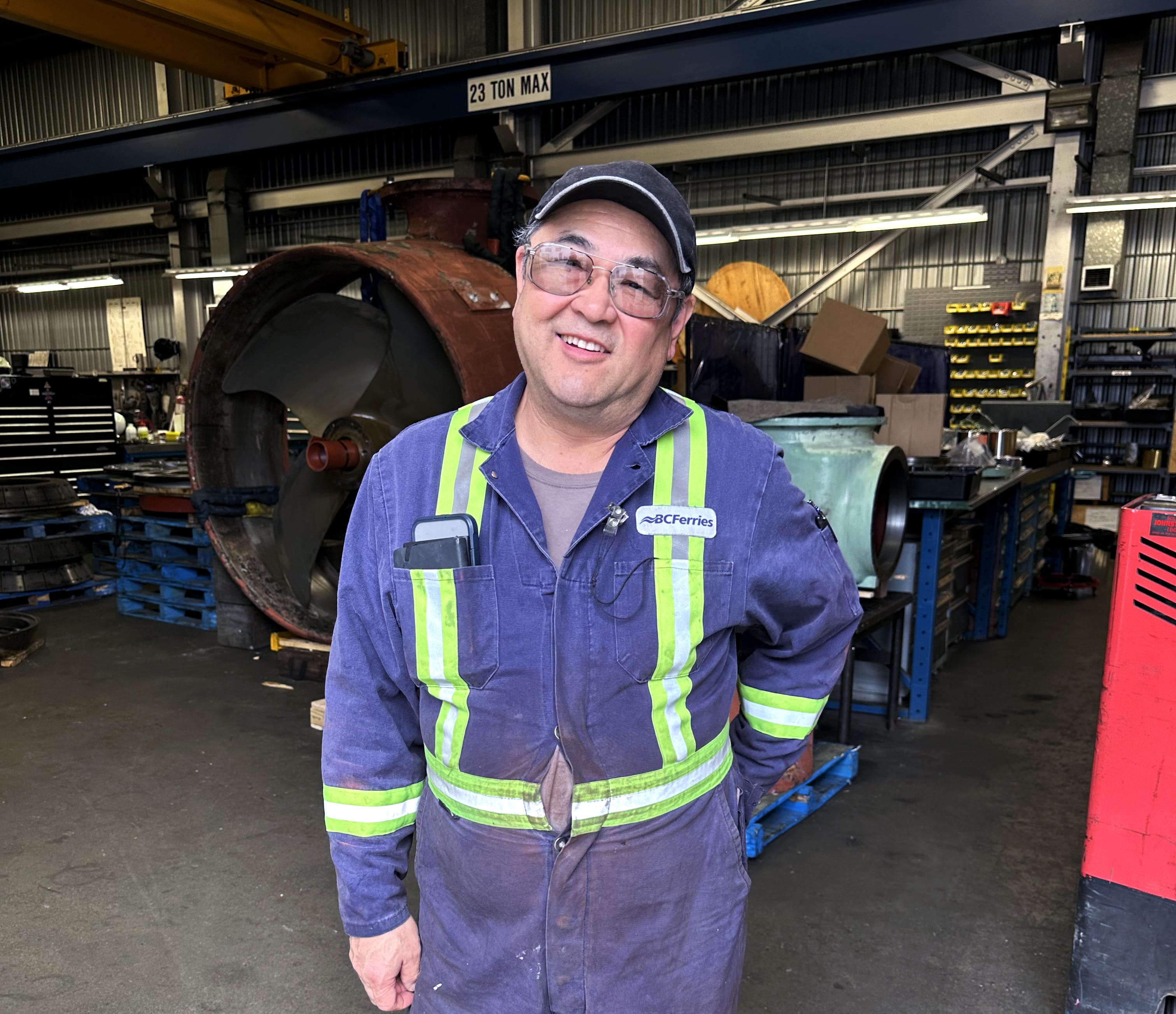
I started working for BC Ferries through my previous job. I was working in the marine industry and BC Ferries was one of our customers. I’d been to the Fleet Maintenance Unit (FMU) site several times. When I learned that  my company was closing its doors at their Vancouver office, I had to figure out what to do next.

One day I was back at FMU doing some work, and I asked a manager if they could use someone like me with specialized experience. They told me to drop off a resume. I did, and the rest is history. I’ve been here nine years now.

I have been mechanic all my life. I got into this marine propulsion industry through a friend a long time ago who suggested I give it a try.

What I like about the job is the challenges I face every day every day could be different. I learn something new even at my age.

A lot of what we do is behind the scenes. Passengers don’t really see what’s going on underneath the vessels, the propulsion systems, the engines, the propellers. That’s my specialty. Most days my work involves working on propulsion, in dry dock or at heavy shop.

Sometimes people see a propulsion unit getting transported on a truck and they ask what it is.  They’ve never seen anything like it before.

Most people don’t realize what it takes to keep these vessels running.

The best part of the job is the people I work with.  Great crews, working tough timelines together.

Every year the timelines seem to get tighter. There are times when we’re working overnight and something unexpected issues comes up. You’ve got a very tight window before the first sailing. You’re right up against it, sometimes finishing just as passengers are starting to board. It’s a lot of pressure.

One of the biggest challenges right now is losing experienced people. A lot of mechanics and engineers are retiring, and it’s hard to replace all that knowledge.

It’s also tough to attract younger workers. Wages are competitive elsewhere, and the cost of living is high. A lot of younger people are moving away because they can get a better life somewhere else.

We also deal with limits on equipment and tooling. Everyone is tight on money, so you make do, but it can make the job harder.

If I could change one thing, it would be more investment into our fleets.  Our fleet is aging. You see breakdowns happening more often. We need modernization.  That takes funding. I think government needs to be more involved in that.

At fleet maintenance we do maintenance service and repair, scheduled or emergency service.  When a ferry breaks down, we go in overnight, fix what we can and get it ready to sail again in the morning.

People don’t always see that part. But it’s what keeps the system moving and I’m proud to be part of that.

Kenji Mitsuhashi, marine mechanic, DEAS Dock component.

Alex Yates: Learning and teaching the ropes below deck

A friend of mine had worked at BC Ferries for years as a deckhand. He told me they were always looking for people and said I should apply. So I went out and took all the courses I needed. I went to a job fair and told the BC Ferries staff there I wanted to be a deckhand. They started listing all the certificates I’d need, and I slid mine across the table and said, “I’ve taken them already.”

They gave me a recruiter’s number and told me to call the next day. When I did, they said they could probably get me into the terminal. It wasn’t exactly what I had planned, but I really enjoyed my time working terminal. It was a great group of people and every day was different. You got to interact with the public and work with a strong team. The only reason I moved to the boats was because I was only getting a shift or two a month at the time and I had a mortgage to pay.

These days I work in the engine room.

One thing people might not know is how much happens behind the scenes to keep the ferries running. When people ask what we do on graveyard shifts, they’re often surprised. They assume the boat is just sitting there, but that’s when a lot of the work happens.

We’re bringing fuel on board, pumping sewage ashore and doing maintenance on engines that have been running all day and finally get a chance to be shut down. A lot of that work has to be done in a five or six-hour window while the vessel is docked. When the crew arrives in the morning, the boat is ready to go. Most people never see what it took overnight to make that happen.

When people do get the chance to walk through the engine room, they’re shocked by the size of everything. The engines are the size of a small school bus. From upstairs, it’s easy to forget what’s underneath you.

This job teaches you how important it is to stay alert. I remember a situation where one of the guys doing his rounds noticed a small fuel spill that hadn’t been there earlier. It’s the kind of thing you only catch if you’re paying attention, if you know the space and what’s normal. We dealt with it right away, but it’s a good example of why our checks matter. There are a lot of systems running on board and catching things early is a big part of keeping passengers safe.

One of the challenges of the job is working with a constantly changing crew. I change start times every couple of days and often work with newer employees, so a big part of the job becomes teaching. If someone hasn’t done a task before, then it’s a learning day. I’ll show them how to do it so next time they can handle it themselves. Eventually, they can teach the next person.

That’s how I learned when I started. On my very first shift, Eric McNeely walked me around the engine room and showed me what he did and how everything worked. He basically went through it piece by piece and said, “This is what I do.”

At the time you’re just trying to take it all in. Later, once you’ve been doing the job for a while, you realize the order he showed things in makes sense. Eric’s our president now, but back then he was the one showing the new guy around the engine room on day one.

Now that I’ve been here longer, I try to pass that knowledge along whenever I can.

I stay involved in the union as a shop steward and the second vice-president of Local 2. I also sit on several site safety committees and our local grievance and convention resolution committees.

Last year I also helped organize the Golf for Graeme tournament, in memory of Second Officer Graeme Barnes, which supports a scholarship in his name to help students pursuing marine careers. We raised nearly $13,500 in under two years. In a close-knit industry like ours, losses are felt deeply. Events like Golf for Graeme are also about reminding each other that mental health matters and that none of us are alone.

Long shifts, changing schedules and time away from family can take a toll. It’s not always something people talk about but sometimes people are going through a lot and nobody realizes it. That’s why it’s important to look out for each other.

Alex Yates, ERR on Watch 9, Nanaimo

Gary Caroline: Building the next generation of union negotiators

I’m the executive director of the BC Ferry & Marine Workers’ Union and I work closely with the bargaining committee as the union’s lead negotiator.

I’ve spent close to 40 years working in labour law. Even before that, while I was in law school, I worked for unions doing their legal work. My father was very active in his union on the railroad and later I took the same path on both CN and CP, so the union movement has always been part of my life.

Before I worked for BCFMWU, I knew of the union as an arbitrator under Article 6. Over the years I had always liked dealing with the staff in the union. I wanted to learn more about the union’s work and how ferry operations affect the collective agreement and the lives of members.

Through the Article 6 charges I had dealt with as an arbitrator, I really felt that members could use help improving their work environment. I wanted to see whether I could have an impact on changing that for the better.

I’m not working for the union as a lawyer, but it certainly helps that I am one. The range of issues the union deals with is broad and a lot of my time ends up being spent helping resolve complicated matters.

What members may not realize is how much time goes into dealing with internal charges, constitutional complaints or human rights issues. That work can be extremely time-consuming.

At the same time, I also work with members and subcommittees trying to improve the workplace, particularly around how women and marginalized groups are treated. I enjoy that work a great deal, even though it can be frustrating at times. In many cases the employer is not as aware of the issues those workers face as they should be.

One of the biggest challenges facing the union right now is workplace culture, right up there with it is the struggle to remove the provision in the collective agreement that has forced interest arbitration when renewing a contract. I was shocked to learn that this provision has been used to deny members the right to strike.

In my nearly 40 years working in labour law, it has become very clear to me that not having the right to strike affects bargaining from A to Z. If the employer knows we can’t lower the hammer to get a fair deal, we are always going to be negotiating from a position of weakness. That said, I am optimistic that this round of bargaining will be the last one where members are impacted by the language in 35.02.

What matters to me is working closely with the bargaining committee. I firmly believe that members are the best negotiators. They know the issues better than anyone. What they sometimes lack is experience with the technical side of bargaining.

One of my goals is to make sure that future rounds of bargaining don’t need outside assistance like me. We want members to have the knowledge and confidence to do this work themselves. I think we’re well on the way to that.

I have tremendous confidence in Eric’s ability to take things forward once I move on to other things.  For me, working with ferry workers and helping strengthen the union has been a way to stay connected to the labour movement that has always been part of my life and pass along some of what I’ve learned over the years. If the next generation of ferry workers can lead their own negotiations with confidence, then I’ve done my job.

Gary Caroline
Executive director, BCFMWU


Inside the BC Ferries refit yard: Christine finds a home for her craft

I joined BC Ferries because I wanted a place where my trade mattered and my skills would be taken seriously. As a woman in the trades, that kind of equal footing is important. The work here is challenging, hands-on and meaningful, and that’s what’s kept me coming back.

I’m an upholsterer by trade. Before ferries, I did custom fine furniture. At Deas Dock, the work is totally different. I make patterns, sew custom covers for navigation equipment and build whatever the ships need. Engineers will dream something up and we take it back to the shop, figure it out and make it. I like the challenge. It’s a real craft and a real trade, and it keeps my brain working. Pattern making is one of my strengths.

There are only four upholsterers in the whole company. Most people don’t know we exist. Even people around the fleet are surprised. But every refit season, from September to June, we touch almost every vessel. We fix every ripped seat, go through all the cafeterias and lounges and take care of anything fabric on board

I love it when someone brings us something new and we get to design it from scratch. Turning an idea into something that fits, works and holds up on a working vessel is satisfying. Those are the moments where I think, “My brain made that.” I feel respected for my skill and get to use my trade every day in a way that challenges me.

Working in a trades yard as a woman has its challenges. You have to earn your respect. Once people see your skills, you’re accepted, but it’s not automatic. I’d like to see more women in the trades and at Deas Dock. It would shift the environment for everyone in a good way. The women who are here are amazing and really skilled.

I’d never been in a union job before BC Ferries, so getting involved was new to me. But our work can be dangerous. People put in long, hard hours around heavy equipment, and you need someone looking out for the workers. For me, being active in the union is about rights, safety and making sure the conditions on the ground match what’s on paper.

Christine Shakespeare, president, Deas Dock Component

Building from the ground up: Darcy Morgan’s Hullo story

Being born and raised in rural Nanaimo, I started in my dad’s footsteps as volunteer firefighter in 1997 and later got all my structural firefighting, hazmat and first aid certifications. The marine industry was never a thought for me until  I applied to BC Ferries in 2010. I worked as a terminal attendant, equipment operator, OFA and terminal supervior.

In 2015, I got a union scholarship for the Bridgewatch Rating Program, did a summer term on the Coastal Renaissance and then moved into a watch position on route two, the Queen of Cowichan. I stayed there until June 2023, when I left for Hullo.

Hullo offered something new and fresh. It felt like a chance to help build something from the ground up and create a service that’s vital for the mid -island. The idea really hooked me, and does to this day.

I really enjoy my job and work with a very diverse group. Some folks have 25 years in the industry and some have 25 minutes. I get to share what I know and watch new people grow, while also learning from everyone I come into contact with.

Most people don’t realize how long our days can be. Our average shift is about 13 hours. If you take the 7 am sailing to Vancouver and come home at 5:30 pm, it’s the same crew bringing you back. We work fewer days a week, but the days themselves are quite long.

My job is also different from the big ferries most people know. Conventional ferries run around 12 to 20 knots. Our service speed is closer to 34. Things come at you fast. You’re close to the water and you’re moving quickly, so the focus and intensity are really high.

Our deckhands do everything. They moor the ship, deal with emergencies, serve coffees, help people who feel sick, handle medical calls and deal with security issues. They’re incredibly well rounded. People don’t always see or appreciate how many different hats they must wear in a day.

Working for a small, start-up company can have its challenges. With collaborative approaches between workers and management, creative solutions can be found. Most challenges are firsts. People really tend to step up, and make sure to keep things moving, finding creative ways to mitigate sick calls and keep boats running as to not interrupt a passenger’s day.

Our biggest challenge right now is scheduling. We run a lot of late-night event sailings for concerts and hockey games which creates a unique challenge of moving crew and sailings around to meet the demand. Being that a lot of events are scheduled on the go, scheduling for the future can prove difficult.

For the customers who rely on us, keeping communication open is key. Weather, technical issues, staffing, whatever it is, people just want updates. We’re already doing a great job in that area but it can always get better.

I never thought I’d end up in the marine industry, but once I started, it just felt right. Hullo’s given me a chance to grow, to lead and to help build something that matters to the community. I’m proud to be part of it. And I’m still a volunteer firefighter: now I’m the assistant fire chief at East Wellington Fire Department on Jinglepot Road.

Darcy Morgan, Chief Officer (Mate) Hullo Ferries

Krista’s story: Finding heart and home on the water

When I first moved to Cortes Island in 2015, I came from a background in education. I wasn’t sure I wanted to keep doing that kind of work, but I knew I wanted to find my place in the community. A few months in, I started doing childcare for someone who worked on the ferry and began asking all the questions: what’s good about the job, what’s hard about it, what’s it really like?

Coming from the Great Lakes in Ontario, I’d never imagined working on the ocean. As I rode the ferry back and forth, I thought, this would be a dream job. You don’t get views like this anywhere else. For a lot of locals, it never gets old and for many passengers it’s the trip of a lifetime.

What inspired me most was the idea of working outdoors, doing physical work, and still being home every day after my shift. I had no idea then that the schedule would turn out to be great, that there’d be room to advance, or that there were so many opportunities for learning and training.

That first year, though, I only worked seven days. Sometimes just getting your name on the casual list feels like a victory. One captain told me, “Stick and stay and make it pay,” and he was right. It can take time. Some people wait years to get full-time work, but it’s worth it. My husband and I even timed starting our family so I’d have a regular position by the time we had a child.

What most people don’t realize is how skilled deckhand work is. Inside our work backpacks, we carry government-issued certificates that look like passports, showing our completed competencies. We take passenger safety management, rescue boat operation, and firefighting training. The first time I suited up in the gear, I felt like a superhero. But what really stayed with me was the weight of responsibility that comes with it; the knowledge that if something happens, we know exactly what to do. We drill and train so our reactions become instinctive.

Loading vehicles is another part of the job most people don’t think about. Our ship is narrow at both ends, so we often guide passengers to really crank their wheels over to fit. It can be stressful. There’s a lot of moving traffic and we have to stay alert and calm. My years of practicing tai chi help me stay grounded. Someone told me this summer that I was the most graceful ferry worker they’d ever seen.

I’ve learned to read the energy of the car deck. It helps to remember that by the time travellers get here, they’ve been on the road for hours. They’re tired, it’s hot, they just want to get to their destination. We stay patient, we check parking brakes are set and we keep each other safe.

The proudest moments for me are when I get to share the experience with others, especially kids. Sometimes we bring families up to the bridge to meet the captain and let their child steer for a minute. Seeing the look on their faces is magic. One day a family came up, and right as we were talking about whales, a pair of humpbacks breached ahead of us, three or four times. It was one of those rare, perfect moments that remind me how lucky we are to work where we do. I love being a look out. One of the masters calls me “hawk-eye,” because I notice marine life and traffic moving a long distance away. An unexpected perk of this job is the time interacting with crew members, mates, masters, and the engineering crew. I had no idea that I’d work in a job where professionals with vast experience would be willing to share so much about themselves. I love learning so this job is definitely one for a lifelong learner!

The biggest challenge right now is crew morale. We’ve had trouble retaining crew and filling positions, which means those of us here take on more. When I first started, we’d have crew meals and get-togethers all the time. That sense of community made the long days easier. Now, with housing costs rising and fewer affordable rentals, it’s harder to find people who can afford to rent a secondary home or find a spot to place a trailer on Cortes. This used to be a job where you could support a family and pay a mortgage with extra money left over. I’m lucky that my husband works so we can afford to live on this beautiful island.

If I could change one thing, it would be to strengthen that sense of solidarity, both in the workplace and within our union. I love being part of a union and connecting with other members. In our local, we’ve been focusing on education and training. It gives us time together, a chance to talk shop and share our lives outside of work too.

It’s easy to forget, with all the routines and schedules, that this job is full of heart. I try to bring that into everything I do and I hope it rubs off on others.

Krista Mandula, secretary-treasurer, Local 11