Twenty-six years, one important lesson
I came to Canada in 1995 from the former Yugoslavia with my master mariner certificate. It took me three years to complete all my examinations again in Canada.
I first applied to BC Ferries in 1998 and applied again in 1999. I was living in Kitchener-Waterloo when they called me for an interview in Little River. I flew across the country, passed the interview and then had a written exam. About 10 days later, they called me and I did the three-hour oral exam over the phone.
Then they called and said, “You are accepted, but we don’t guarantee you anything. We don’t guarantee you work. We don’t guarantee you money. The only thing we require is that you have a car.”
So I got in my car.
I left my wife and daughter in Ontario and drove for four days to Little River. I arrived on July 25, 2000. They told me my first training assignment would be in Alert Bay. Of course, I had no idea where Alert Bay was. They said, “Just go straight north and you will reach your destination.” I asked about my uniform. They told me Alert Bay was a big port and everything would be waiting for me there. Of course, nothing was waiting for me.
But the people were wonderful. Everybody found something for me. One person gave me one part of a uniform, somebody else gave me another, and eventually I had enough pieces to be ready for training.
When I started, I was No. 12 on the casual list. No. 12 did not give you very much work. But I was lucky. At the time, we didn’t have SEA trainers. When I didn’t have work, I would call and ask if I could go somewhere else to train. We would shadow experienced chief officers and captains.
Within about a year, I managed to get my 1,800 hours for benefits. I was cleared on 13 ships and eight terminals, as a mate, chief officer and eventually captain.
It was a great experience. I learned ship handling in all kinds of weather conditions and had the opportunity to work on very different vessels, with different propulsion and operating systems.
Before coming to BC Ferries, I worked deep sea and served in the Yugoslav Navy. I became a captain, or commandant of a ship, when I was 24 years old. I remember the celebration when I was promoted from chief officer to commandant. We had a big party.
The next morning I woke up and realized something important: I had the knowledge of a chief officer. I did not suddenly have the knowledge of a captain just because somebody had given me the rank. I was lucky. My chief engineer had 20 years of experience. The people around me had enormous experience. That taught me something I have carried through my whole career: value the people you work with.
It doesn’t matter what position you have. Even the captain is only one part of the team. Without the people around you, you cannot be successful.
Eventually, in July 2001, my wife and daughter came to Victoria. For the next five years, my point of assembly was Little River while I lived in Victoria. Sometimes I would drive all the way to Alert Bay for one day of work and then drive all the way home again.
What has kept me here for 26 years is the people. The best part of BC Ferries is the people on the ships. I have been very lucky to work with people who helped me from the beginning and continued helping me throughout my career. They are knowledgeable. They are good people. And they are the reason I have enjoyed this work for so long.
One experience I will never forget happened while I was working as chief officer on the Spirit of Vancouver Island. We were coming into Tsawwassen and were maybe a mile away when a passenger reported that a woman had jumped into the sea. The captain made an excellent manoeuvre and turned the ship around. We spotted her about 150 metres away. She was dressed completely in black, and it was very difficult to see her in the water.
Our crew had the rescue boat in the water within minutes. The sea was extremely rough. Water was coming into the rescue boat. They reached her incredibly quickly and brought her back to the ship. By then, she wasn’t breathing. Fortunately, there was a doctor on board who immediately began first aid. A helicopter came and took her to hospital.
She was only about 25 years old. She survived.
I was so proud of that crew. Their training was there when we needed it. They were fast, they knew what to do and they saved a life. That is what experience, training and a good crew can do. One of the deckhands who went out in that rescue boat is a senior master today.
I came from a country where unions were part of every workplace. Workers had a strong voice in decisions, and I saw the value of that.
A company has its priorities. It has budgets. It wants ships to be on time. It has many things it needs to achieve. But sometimes those priorities come into conflict with safety. Workers need a voice because we are the people doing the work. When we raise concerns, I hope the company understands that we are doing it in the best interests of everyone.
If we listen to one another and find better solutions, everybody goes home safely.
When I worked as a chief officer, I used to say something to the deckhands when they were working with ropes.
I would ask, “Do you know what we are not?”
They would look at me.
“We are not lizards.”
One wrong move and you can lose a finger, and it is gone for the rest of your life. It does not grow back. That is why the workers’ voice matters.
If I could change one thing today, I would make sure we continue learning from the people who have spent years doing this work.
Sea training is a very good thing. But there is also enormous value in the way we used to learn, by shadowing the person with the most experience and gaining knowledge directly from them.
I learned some of the most important things in my career not from the people with the highest rank, but from people in lower positions who had a tremendous amount of experience. You can’t replace that.
Having spend 26 years on 33 BC Ferries’ ships, that’s the biggest lesson I can share. Listen to the people around you. Respect their knowledge. Talk when you disagree and appreciate another person’s point of view.
And always remember: we are not lizards.
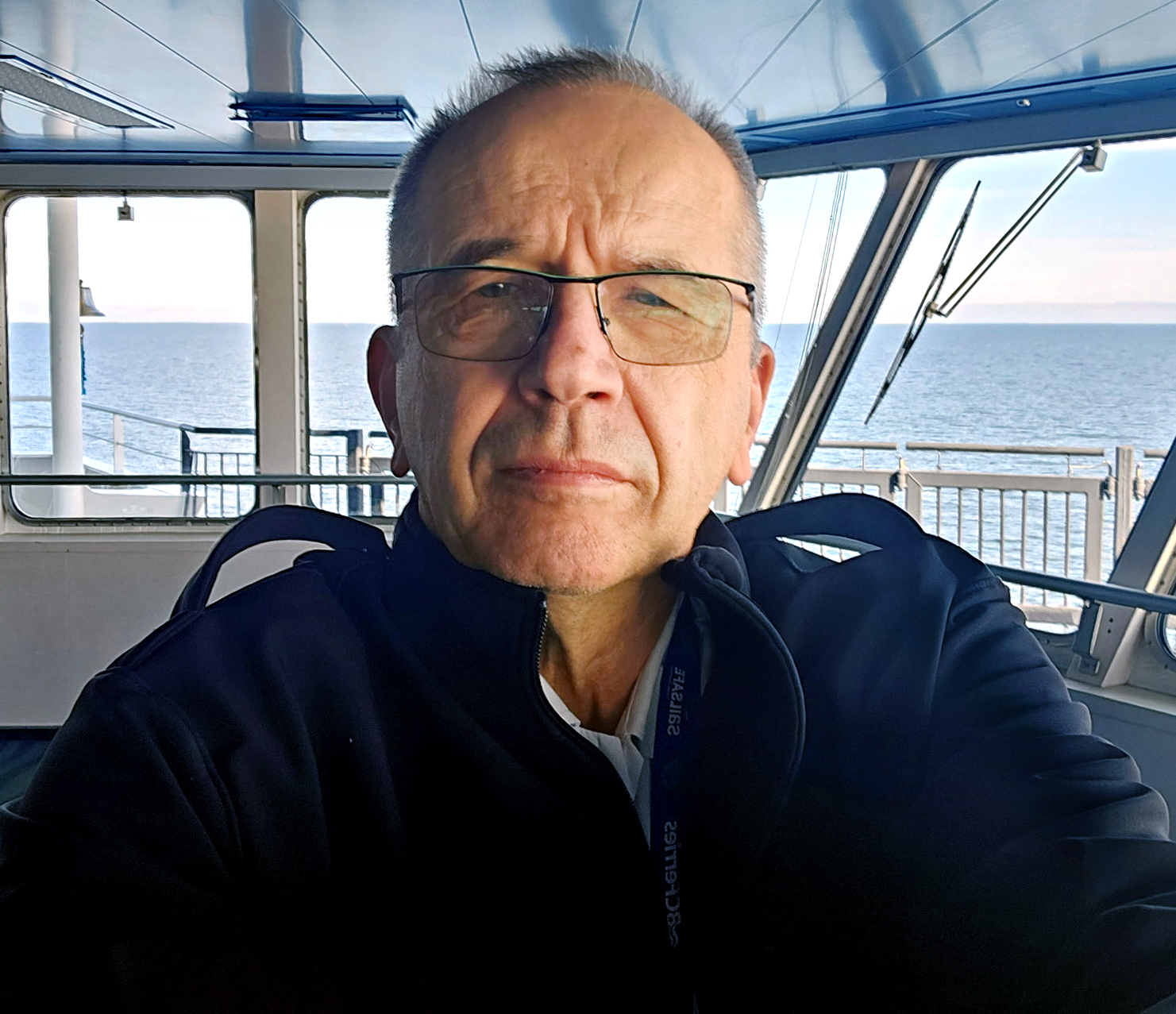
Stojan Perisic, Chief Officer- Relief Master (Spirit), Local 18