2025 budget: Ottawa missed the boat

The 2025 federal budget commits $6.6 billion in Canada’s defence shipbuilding industry and major national projects. But one critical piece is missing: support for ferry-dependent communities in British Columbia.

Budget 2025 also celebrates lowering fares for ferry users in Atlantic Canada, but there’s no new passenger subsidy for B.C., where ferries are not optional. They are the daily commute, the grocery run, the medical trip and the way families stay connected to the national supply chain. Canadians deserve equal treatment no matter which coast they live on.

Ferry-dependent communities have already raised concerns about service delays and reliability. As Gibsons’ Mayor Silas White recently said, “People’s lives are being impacted significantly… service disruptions and delays are unacceptable.”

Those challenges are made worse by a funding model that treats the coasts unequally.

Also missing from this budget is targeted support for marine sector training and recruitment. There is no dedicated support for marine officer education, or training for engineers, deckhands and other ferry-specific workforce development in B.C.

Finally, a national approach to shipbuilding must include passenger ferries. If Ottawa can invest in military fleets to protect our coasts, it should also invest in fleets that connect our communities.

During the federal election, Mark Carney said he would consider federal ferry support for British Columbia. This budget doesn’t follow through on that commitment.


Lest We Forget: Honouring Remembrance Day.

On Remembrance Day, we honour Canadians who served and sacrificed for our freedom, including the many veterans and active service members in our communities and in our union family.

The union hall will be closed on Tuesday, November 11. Our flag will be flown at half-mast in recognition of those who served. We know many of you will still be on duty that day, moving coastal communities and keeping passengers safe. Thank you for your service on the vessels, in the terminals and in the yards.

If you need assistance while the hall is closed, your local presidents are available to support you.

Lest we forget.

Krista’s story: Finding heart and home on the water

When I first moved to Cortes Island in 2015, I came from a background in education. I wasn’t sure I wanted to keep doing that kind of work, but I knew I wanted to find my place in the community. A few months in, I started doing childcare for someone who worked on the ferry and began asking all the questions: what’s good about the job, what’s hard about it, what’s it really like?

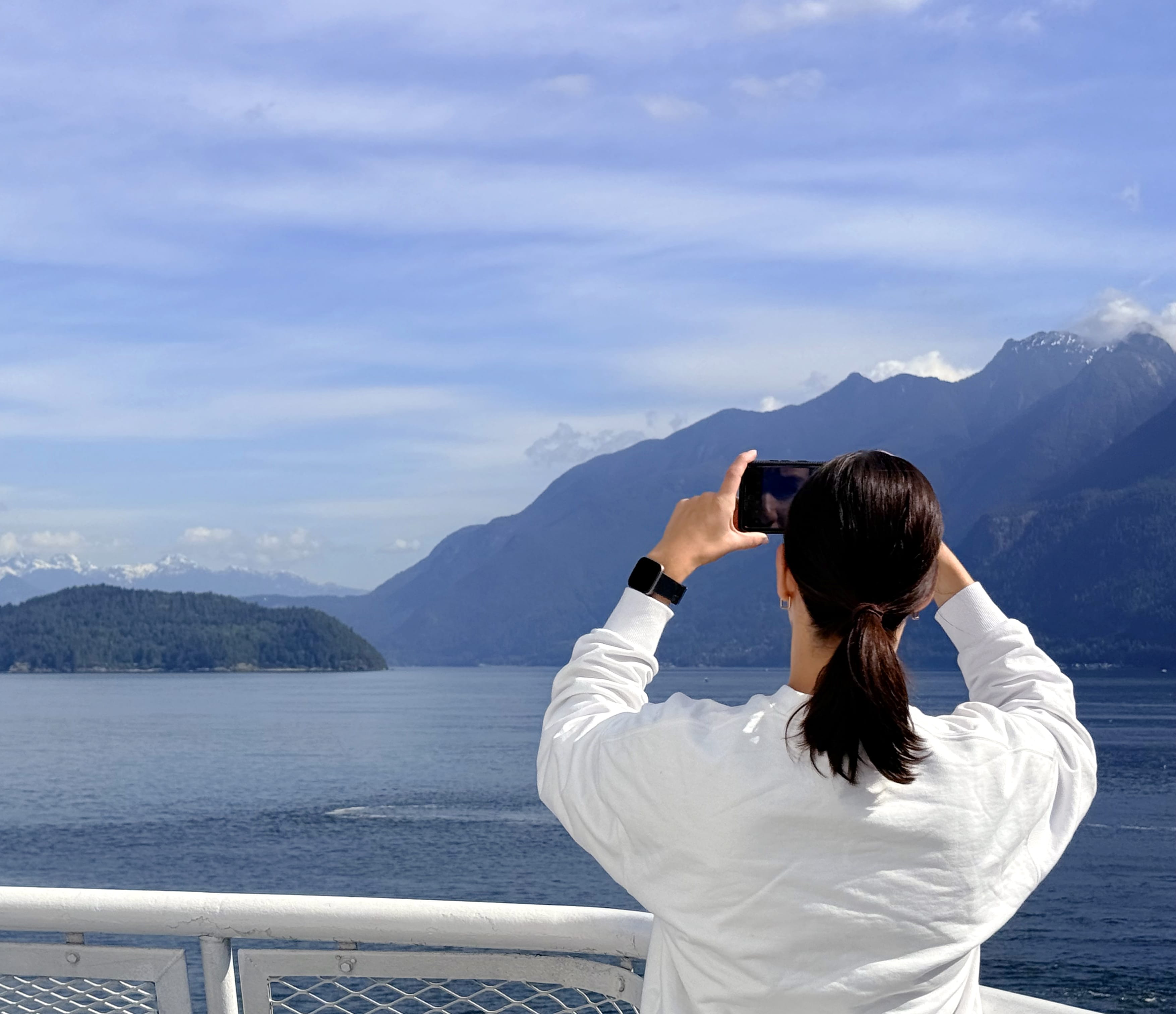
Coming from the Great Lakes in Ontario, I’d never imagined working on the ocean. As I rode the ferry back and forth, I thought, this would be a dream job. You don’t get views like this anywhere else. For a lot of locals, it never gets old and for many passengers it’s the trip of a lifetime.

What inspired me most was the idea of working outdoors, doing physical work, and still being home every day after my shift. I had no idea then that the schedule would turn out to be great, that there’d be room to advance, or that there were so many opportunities for learning and training.

That first year, though, I only worked seven days. Sometimes just getting your name on the casual list feels like a victory. One captain told me, “Stick and stay and make it pay,” and he was right. It can take time. Some people wait years to get full-time work, but it’s worth it. My husband and I even timed starting our family so I’d have a regular position by the time we had a child.

What most people don’t realize is how skilled deckhand work is. Inside our work backpacks, we carry government-issued certificates that look like passports, showing our completed competencies. We take passenger safety management, rescue boat operation, and firefighting training. The first time I suited up in the gear, I felt like a superhero. But what really stayed with me was the weight of responsibility that comes with it; the knowledge that if something happens, we know exactly what to do. We drill and train so our reactions become instinctive.

Loading vehicles is another part of the job most people don’t think about. Our ship is narrow at both ends, so we often guide passengers to really crank their wheels over to fit. It can be stressful. There’s a lot of moving traffic and we have to stay alert and calm. My years of practicing tai chi help me stay grounded. Someone told me this summer that I was the most graceful ferry worker they’d ever seen.

I’ve learned to read the energy of the car deck. It helps to remember that by the time travellers get here, they’ve been on the road for hours. They’re tired, it’s hot, they just want to get to their destination. We stay patient, we check parking brakes are set and we keep each other safe.

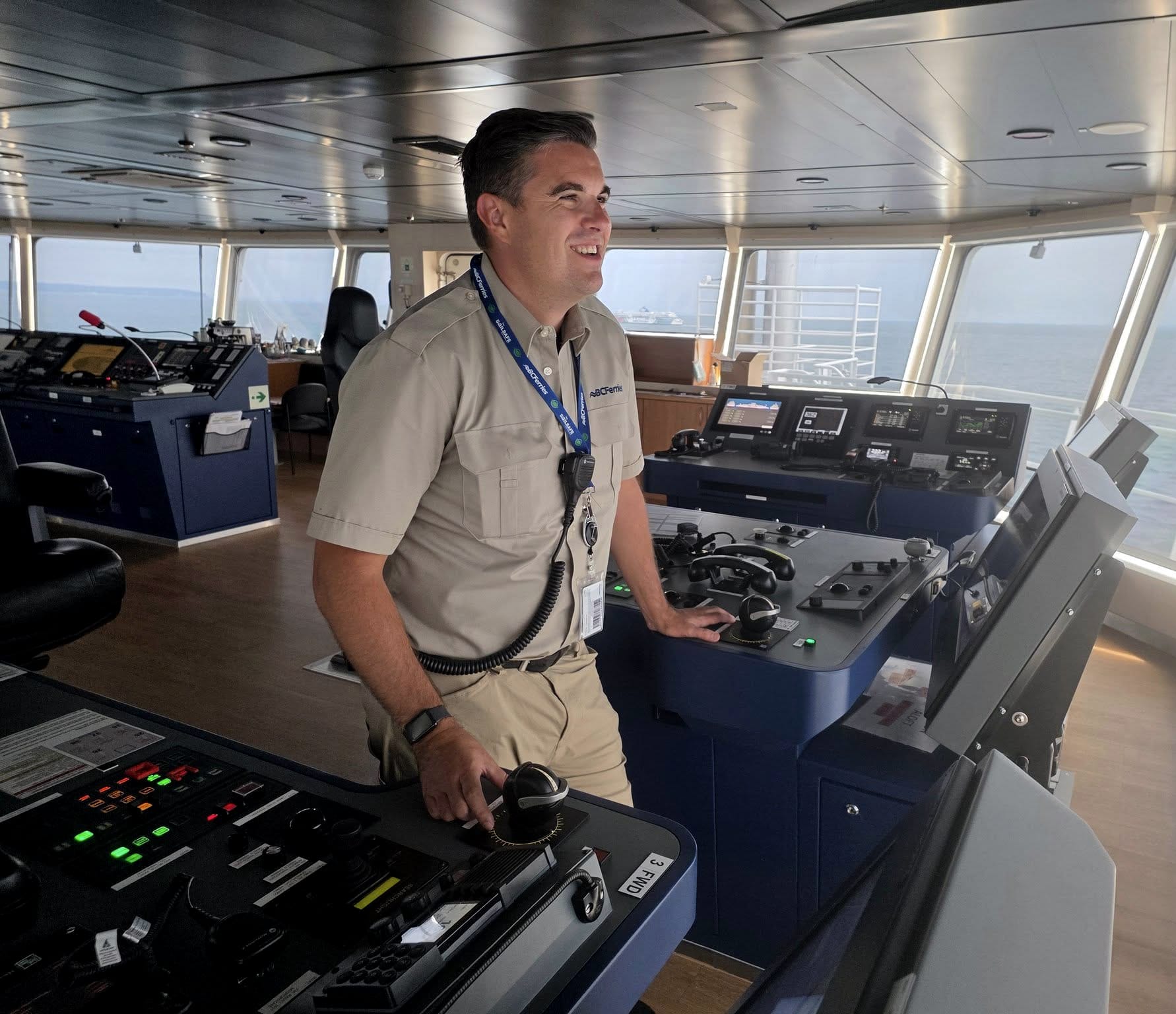
The proudest moments for me are when I get to share the experience with others, especially kids. Sometimes we bring families up to the bridge to meet the captain and let their child steer for a minute. Seeing the look on their faces is magic. One day a family came up, and right as we were talking about whales, a pair of humpbacks breached ahead of us, three or four times. It was one of those rare, perfect moments that remind me how lucky we are to work where we do. I love being a look out. One of the masters calls me “hawk-eye,” because I notice marine life and traffic moving a long distance away. An unexpected perk of this job is the time interacting with crew members, mates, masters, and the engineering crew. I had no idea that I’d work in a job where professionals with vast experience would be willing to share so much about themselves. I love learning so this job is definitely one for a lifelong learner!

The biggest challenge right now is crew morale. We’ve had trouble retaining crew and filling positions, which means those of us here take on more. When I first started, we’d have crew meals and get-togethers all the time. That sense of community made the long days easier. Now, with housing costs rising and fewer affordable rentals, it’s harder to find people who can afford to rent a secondary home or find a spot to place a trailer on Cortes. This used to be a job where you could support a family and pay a mortgage with extra money left over. I’m lucky that my husband works so we can afford to live on this beautiful island.

If I could change one thing, it would be to strengthen that sense of solidarity, both in the workplace and within our union. I love being part of a union and connecting with other members. In our local, we’ve been focusing on education and training. It gives us time together, a chance to talk shop and share our lives outside of work too.

It’s easy to forget, with all the routines and schedules, that this job is full of heart. I try to bring that into everything I do and I hope it rubs off on others.

Krista Mandula, secretary-treasurer, Local 11

BC Ferries is leaving British Columbians waiting

Recently, coastal mayors criticized BC Ferries for leaving ferry-dependent communities in the lurch, pointing out that cancellations and delays have increased while service has declined. BC Ferries’ response, that smaller routes operate at a deficit, was revealing.

President Eric McNeely recently shared his perspective on what needs to change to make sure BC Ferries serves coastal communities better.

‘We don’t measure hospitals or highways by profit and loss, and we shouldn’t treat ferry routes that way.”

President McNeely points out that Premier W.A.C. Bennett never intended our ferry system to run as a business. Rather, he saw it as a “marine extensions of the highway system,” designed to connect communities up and down the coast.

Instead, we’ve ended up with a private company that delivers a public service without public accountability.

“The fix is straightforward. Replace political appointees with a genuine public-interest board that’s independent, qualified and transparent. With real oversight, BC Ferries can be held accountable. This requires legislative change. The Coastal Ferry Act must be amended to reflect the needs of residents, not the demands of a failed business model.”

Read the rest of President McNeely’s thoughts here.


Statement on Canada Pulse Insights poll

We get it. People want new ferries now.

We know better than most that BC Ferries needs new ships. We operate and repair the ships you rely on every day.

We also know that when we build ferries overseas, we lose thousands of good jobs, apprenticeships for young people and hundreds of millions in local tax revenue.

A poll that only asks if people want to cancel a deal offers a false choice. Ask if they want to lose 10,000 jobs and a billion dollars in local wages, and you’ll get a different answer.

It’s easy to say yes to a poll question when you’re only told about penalties and delays. The real penalty is losing jobs, tax revenue and the ability to build our own ships.

That’s money that should be putting pay cheques into our communities, not creating jobs overseas.

This poll surveyed 657 people in Metro Vancouver. It didn’t ask the people who work on ferries, build them or depend on them every day.

The simple fact is we lose more than we gain with this deal, and we’ve known this for some time.

A 2014 Columbia Institute study found for every 100 shipyard jobs, another 135 are created across local suppliers and service industries.

In 2024 the BC Chamber of Commerce urged the province to include a “build-in-B.C.” requirement for new ferries, noting it would create up to 9,800 jobs, $1.7 billion in wages, $1.1 billion in GDP and $234 million in provincial tax revenue.


Category Estimated loss to B.C.
Wages $1.2 billion
GDP $1.1 billion
Jobs 9,800
Tax revenue $234 million

For decades, every vessel in the BC Ferries fleet was built right here in B.C. Then we stopped betting on British Columbians and started losing control of our industry and our supply chains.

Let’s make sure this is the last time public money and good jobs leave our shores

Write to your MLA today.

Keeping the island’s shelves stocked, one trailer at a time

I came to BC Ferries about sixteen years ago, but it wasn’t really my idea. I was working long hours on the highway when a friend called to offer me a job. I said no because I already had one. Then he went behind my back and called my wife. She told me I needed a change. She was right. I was working eighteen-hour days. She wanted me home safe, and I wanted peace in the house, so I said yes. I went to see him at Duke Point, gave notice at my old job, and started soon after. I’ve been here ever since.

I move food trailers that come over from Vancouver to the island. Every day we move about sixty trailers full of food, lumber, fish and other supplies. Everything people rely on. If you buy it in the grocery store, it probably came on off the ferry. Most passengers never think about our trailers as supply lines when they’re waiting in line.

If there’s ever an earthquake or big emergency, our trailers are cleared to go first. Food, water and medicine move before anything else. We’re a lifeline for the island, and that feels good to know. The faster we move goods, the faster they reach stores, restaurants and families. Other sea transport services for cargo can take twice as long, but we can turn it around in two and a half hours.

It’s a busy job, but every now and then there’s a moment that reminds me why I love it. A few years ago, an older woman couldn’t get her car started at the terminal. She thought the battery in her key fob was dead, so I took mine apart, gave her my battery and it worked. She was so grateful she sent a letter to the terminal manager. It wasn’t a big thing to me, just helping someone get home. But it feels good to help people.

I’ve worked in transport forty-five years. BC Ferries will probably be my last stop before I retire. I’ve enjoyed working with my colleagues, the shore crews and everyone on the ships. We’ve had some good laughs and plenty of stories to go around. It is always sad to lose someone that you have worked with as well.

I’m proud of what I do. Every trailer I move means full shelves, hot meals and steady work for people across the island. That’s something to be proud of.

Raj Ali, Local 2 Commercial Services Driver

MEDIA RELEASE | Ferry workers report abuse and threats ahead of holiday travel

For immediate release
October 10, 2025

Ferry workers report abuse and threats  ahead of holiday travel

NANAIMO — As Thanksgiving weekend approaches and terminals brace for record traffic, a survey of BC Ferry & Marine Workers’ Union members shows crews are facing disturbing levels of abuse from passengers.

“Behind every sailing is a crew doing their best to get British Columbians where they need to go. They shouldn’t have to fear being screamed at, spat on or threatened in the process,” said Eric McNeely, union president.

More than 80 per cent of respondents said they’ve been threatened with violence on the job while 92 per cent have witnessed it. Nearly 65 per cent say the incidents have affected their mental health. Nearly half of respondents said violence or aggression at work has made them consider quitting.

“Protecting workers isn’t optional. Lose them, and the whole system sinks,” said McNeely.

While most workers know how to report violence on the job, only one in four believe the company takes incidents seriously when reported. The union is calling for stronger enforcement of safety policies and real consequences for passengers who abuse or threaten workers.

“We need BC Ferries to back up our crews,” said McNeely. “It’s easy. If you threaten a worker, you don’t sail.”

McNeely said the message is simple, but so is the reminder to the public: “Ferries will be packed this weekend. Patience and kindness go a long way. Our members are out there in every weather condition, making sure you get where you need to safely.”

-30-

MEDIA CONTACT
Rachel Garrick | Communications Officer | BC Ferry & Marine Workers’ Union
| 604-561-3703 | rachelgarrick@bcfmwu.com

The BC Ferry & Marine Workers’ Union represents more than 4,500 ferry and marine workers across British Columbia. From deckhands and terminal workers to engineers and stewards, we keep the coast moving.

Thanks to the crews who keep B.C. moving 🍂🥧

While many British Columbians are carving up turkey and pumpkin pie, ferry workers will be out there, sailing, fixing, loading, cleaning: doing their best to get everyone where they need to go.

Our union hall is closed Monday October 13th, but local and component presidents and shop stewards are on duty for anyone who needs help.

To everyone working this weekend: we see you, we’ve got your back and we’re thankful for the heart you put into this job every single day.

Almost 10,000 jobs lost; leaked report shows B.C. could have built ferries

The leaked Seaspan report confirms what we’ve said all along: BC Ferries vessels could and should be built in British Columbia. Instead of investing at home, leadership is focussed on sending billions overseas, ignoring nearly 10,000 jobs, $1.1 billion in economic activity and $234 million in tax revenue.

This was a failure of leadership. Without Canadian content rules, local yards couldn’t compete against heavily subsidized foreign labour. Other countries build capacity by phasing in work. The report showed how B.C. could have done the same, starting with outfitting, then partial builds, then full builds.

Canadian shipyards didn’t refuse to bid because they lacked capacity. They stepped back because the process prioritized rock-bottom prices. As George McPherson of the Shipyard General Workers’ Federation told the federal transportation committee last week, preparing a bid is a massive investment. No yard will waste resources when there’s no hope of winning.

Public feedback gathered by the BC Ferries commissioner earlier this year showed strong support for building here at home. British Columbians were clear: our money, our shipyards. To suggest customers only want the cheapest ferries erases what the commissioner actually heard.

Canadian workers cannot compete on cost against a state-subsidized industry that relies on low wages and poor labour standards. Focusing on $230 million in refit work over the life of these vessels ignores the billions in jobs, taxes and supply chain growth that could have stayed in B.C.

Once again, BC Ferries’ broken governance model has failed to protect the public interest.

The path forward is still open. The last vessels of this program should go to B.C. yards, with real Canadian content rules. British Columbia deserves ferries built here, by us, for us, for generations.


Progress on clean-shaven rule thanks to members’ efforts

WorkSafeBC will review the “clean shaven” respirator requirement (OHSR section 8.39) on an expedited basis, with consultation and a public hearing planned for November 2025.

Progress on this issue follows the strong advocacy of our union and the determination of members who spoke out and pushed for change.

This outcome is the direct result of members raising concerns, attending meetings, and keeping the pressure on.

Thank you to everyone who helped move this issue forward.

We’ll share details on the public hearing as soon as they’re available. Stay tuned and be ready to add your voice.